Friday, May 3, 2024

Doing hanfod.NL things

With apologies for not putting anything new in this blog for ages - part of the reason for that is hanfod.NL kicked in and that has been quite productive. Maybe check it out...?


Saturday, March 6, 2021

Automatic translation and bilingualism

Ymddiheuraf am unrhyw drosedd y gallai'r ddelwedd hon ei hachosi.
Some of us are getting used to seeing automatic translation offered in various platforms. Google Translate has helped with communication in many and varied settings, not least the mobile app version. Facebook and Twitter will offer to translate posts. Microsoft have integrated automatic translation into their Office365 email. Simultaneous automatic translation is available to viewers of Office365 PowerPoint Online presentations. This is easier for the 'Tech Giants' with massive development budgets and a global, multilingual, market. For lesser firms, the impetus, funds and rationale may be less substantial to the point that automatic translation will just have to wait.
And why not? I will come back to this. First I must add that I do think of this post and the matters discussed within it in terms of networked learning but I will leave the reasons for that implicit for now.

Monday, November 9, 2020

Promoting connections around the fringes of virtual classes

Who remembers queuing in awkward silence... which eventually led to carefully negotiated acquaintance and possibly lifelong friendships, or at least learning where you were meant to be next? Social Network Analysis takes a look at who interacts with who on the basis of digital activity traces in terms of the data recorded about interactions. I'm wondering how a typical SNA map of a class/lecture would look before and after the COVID flip to online versions. We used to worry about student chatter in lectures. While this is happening less, if at all, in online classes, and we are glad to still bring students to an 'event', they now join with blinkers on: zooming into the session and back out again causes a kind of tunnel vision with respect to peers. In SNA terms, this would look like a particularly tight hub and spoke network. Although a lecture format is sometimes mocked for requiring one-way traffic from the lecturer to the students, in fact there is a lot more latitude for connections in a lecture setting than zoom, unless there are deliberate efforts to break up those hard-wired spoke-to-hub connections. There actually is no-one else in the room to turn to - what chance purple and black will rub virtual shoulders? How can we enable or promote connections between students? Would putting students into breakout rooms at regular intervals be enough to enable the helpful social learning milieu...? Would #togethermode ...?


PS. Lesley Gourley's keynote at NLC2020 https://www.networkedlearning.aau.dk/nlc2020/keynote-speakers/#402217

Tuesday, May 12, 2020

A Networked Learning Disposition? Round Table at NLC2020

I am looking forward very much to the online/lockdown version of the Networked Learning Conference next week. A lot more people will be able to attend now that it's gone fully online so it will be a very different experience in various ways.
I'm delighted to be hosting a 'round table' discussion on the first day from 13.30-15.45. I'm expecting a lot more people in the room but also, because there's no physical movement required to room-hop, I think people will be far more transient in their attendance - there will be drive-by's.
The topic of 'disposition' is one that has been gnawing at me for a while. The round table format should allow plenty of time for others to also chew back at it. The question I have is whether there is a disposition towards being the ideal networked learner. It relates to a previous question I framed on this blog in 2008, 'what characterises the networked learned'? Are there things about you (apart from sheer privilege!) that make you a good match for networked learning? This is not the same as learning styles although some of the trait words used there may crop up here. I've been working up a mindmap about disposition and I'm looking to my partners in next week's round table discussion to help with developing and refining ideas and implications of this for networked learning practice, design and research. The mindmap for that is embedded below - it's a wikimap so if you want to, go ahead and add some ideas. It makes sense to try and write it all up and I'm keen to acknowledge any contribution. Probably there are whole swathes of knowledge about 'disposition' I'm unaware of so even a tip-off would be appreciated. If you wish to suggest any, please go ahead and add them to the References GoogleDoc: https://bit.ly/nlc2020dispositionrefs

For a bit more context, Michael Gallagher took up the idea of 'disposition' for his paper at Zagreb's NLC2018. His paper is in the NLC archive and his blog post includes the slides. Among many excellent points, he addressed the critique of 'disposition' being deterministic: post-human perspectives of shared agency should also allow us to avoid that dead-end.
It was great to share the same session with Michael to present my paper on mobilage, originally blogged here in 2017.

Wednesday, April 22, 2020

NLindex

A few weeks ago, a brief exchange on twitter highlighted a difficulty common to many fields: how to enable a way in to the literature.
There are lots of ways of providing an index. Google Scholar does some of it. I don't think any of the databases cover the NL conference archive, and we might want to include other non-NLC sources anyway. We have a saying, 'he who has the vision gets the job'.
Joe used Kumu for his Knowledge Hub. Kumu allows for various ways of presenting the same information, so was preferred over CMAPS, as good as that is. Kumu's free for public maps. Anything that requires effort needs to be reasonably durable and Kumu appears to have that. It also has an CSV import, which, data cleaning notwithstanding, could save a lot of time hand-coding. There may be no way to avoid some of that.
Although in lockdown, Alice kindly sent me 3 exports from the SCHED app used in the previous 3 conferences. So, when I can get to it, this presents a viable way forward. It will still require a fair bit of data cleaning and there are some decisions to make... E.g. whether to re-host the papers, where possible. If anyone is interested to help with this project, do get in touch. There could be some bread pudding in it for you...

Bread pudding

Wednesday, October 9, 2019

Venn Diagrams, digital scholarship

Since I read it, I have admired Robin Goodfellow's (2013) chapter, The literacies of ’digital scholarship’—Truth and use values.' For me it contains a two things of note. One, a succinct definition of scholarly values worth serious reflection in these neoliberal days (see Appendix below). Two, a critique of 'the digital' which contrasts two books, one by Christine Borgman and another by Martin Weller: 'Borgman is trying to make digital scholarship more scholarly, Weller is trying to make it more digital.' (ibid. p75)
In my experience and, not least because of my incredible life privileges, I find it is relatively easy to 'do digital', and I have a disposition so to do. I find that others do not have this disposition, but still 'get the job done'. Through earnest scholarship, they develop their own practices which may be more or less digital, even if vicariously digital (e.g. getting someone else to type things up), but they cannot avoid having to use a computer occasionally.
Recently, I have been teaching the concepts of searching for literature using Boolean operators and I love a Venn diagram to make the point. I think they also help to make a point about 'the digital' and what different people take up in the context of academic work.
In the first diagram, we have Scholarly OR Digital practices. In some ways, this reflects the reality that we all swim around in bits of both.


There are still people, you might know some, you know, the kind that own 'brick' phones, if they have a mobile at all. These are the 'NOT' people. If they 'do' social media, they do it because someone else is handling it for them. Perhaps they are self-confessed draconian Luddites but their scholarship and contribution would be generally deemed successful.


Then there are the 'AND' people, who scarcely do anything without it in some way 'being digital'. Are they any more successful at scholarship for this than the NOT's? What mattered? 

[Apology - this is an 'early version' of the AND diagram - it should be shaded in the middle/overlap but that's a bit tricky in google drawings so I will/may attend to that at another time.]

Appendix: Robin Goodfellow defines the scholarship orientation
This orientation [scholarship] values critical reflection, the cumulative aggregation of knowledge and understanding, distinct modes of operation relating to evidence and the war- ranting of its reliability, and the ethic of enquiry as a primary motivation (Andresen 2000; Cowan et al. 2008; Courant 2008). The combination of these characteristics is what distinguishes the construction of academic scholarly knowledge from other kinds of knowledge production (factual knowledge, practical knowledge, common-sense, morality, the wisdom of crowds, etc.). The existence of communities dedicated to these values in a general sense also distinguishes the sites of production of academic scholarly knowledge (universities, research institutes, museums) from most other arenas of social knowledge practice. (Goodfellow 2013 , p. 69)

Goodfellow, R. (2013). The literacies of ’digital scholarship’—Truth and use values. In R. Goodfellow & M. R. Lea (Eds.), Literacy in the Digital University: Critical Perspectives on learning, scholarship, and technology (pp. 67–78).

Wednesday, May 16, 2018

NL conference does NL

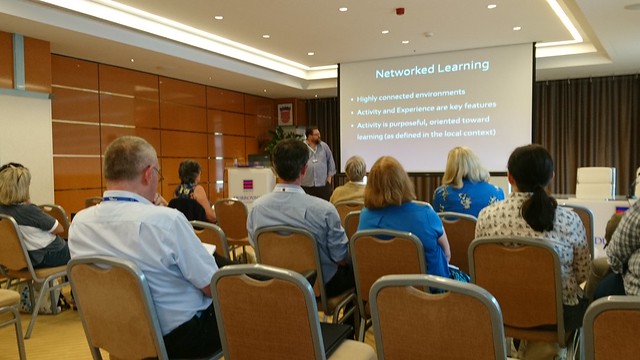
Ben Kehrwald presents on Cognitive Load Theory and NL
Who is doing 'Networked Learning' here?

It was such an honour to chair this morning's parallel session. We had some of that famous networked learning concept creep between Nina and Jens, David and Vivian's papers. To my mind, the conference has always permissively allowed even the likes of me (Johnson, 2008) to play with the standing conference definition of networked learning. In this post I draw attention back to the ancient csalt definition of NL quoted in full here: http://csalt.lancs.ac.uk/jisc/definition.htm
Networked Learning
We define 'networked learning' as:
learning in which C&IT is used to promote connections: between one learner and other learners, between learners and tutors; between a learning community and its learning resources.
Some of the richest examples of networked learning involve interaction with on-line materials and with other people. But use of on-line materials is not a sufficient characteristic to define networked learning.
The interactions between people in networked learning environments can be synchronous, asynchronous or both. The interactions can be through text, voice, graphics, video, shared workspaces or combinations of these forms. Consequently the space of possibilities for networked learning, and the space of potential student experiences, is vast. 
This definition makes it plain that the authors, for obvious reasons, stated that, for them, networked learning with 'on-line materials' was insufficient to be considered networked learning. They required 'interaction... with other people in networked learning environments'.
But this morning some are saying that this is also missing something.
The point was made, with approval, that the networked learning conference does networked learning. Further to the seminar, I want to play back Nina's thesis (today, and in 2012) that, to qualify, and even succeed for any amount of time worth the effort, NL depends, not just on interaction between people, but on the 'concrete' practice of what is being learnt via NL, i.e. to be deployed/practiced in actual contexts (like Nina's example of 'teachers in front of 5th Grade', or like us every 2nd year @NLConf for David and Vivian's paper). 
In other words, and with an eye to the neoliberalism killing off the very idea of a university, networked learning conference delegates, by definition, have to regularly meet up in person, physically co-located, to achieve networked learning worthy of the name.
This leads to another related point, and that is, that the original definition also asserts a focus on (digital) information technology.
As at least a sop to the csalt definition, we can run with the idea that the technology, especially digital information technology use, can be tacit, or remain understated... Partly because it makes a refreshing change to downplay tech. Of course IT is implicated - someone in the room will be tweeting or whatever, regardless of how that affects their ability to concentrate on what's really going on in the room.
If we put the definition up for an arguably timely refresh, what would we end up with if IT was dropped altogether from the definition, left implicit, and instead of it there was a requirement to 'meet up in person'...? How would such a definition read? What are the implications for the future of the nascent field as it moves towards life without the presence of its first generation scholars? 
Given the above, how does the networked learning conference, community and delegates, 'do' networked learning?
Put Denmark, May 2020 in your diary to find out because it seems like 'being at the conference' is important.

Nina:
Nina in 2012: http://www.networkedlearningconference.org.uk/past/nlc2012/abstracts/pdf/dohn.pdf 

PS. I foolishly determined to write this blog post on my phone. This went ok in evernote, even if the hyperlinks were not automatically being picked up so that gets a real faff to sort out on a phone. Then I copy/pasted the text into the blogger app which went ok apart from losing the links again - should have known better. The next gotcha was when I dared to add a picture to the post. This was possibly too high resolution for the app to cope with at some level so it failed to publish and I had to copy the text into another new post but by that time had lost the will to try and tidy up the hyperlinks etc. This morning, I have revised the text, added the hyperlinks, added a photo, tweaked formatting - so much easier than on my phone.

Wednesday, December 27, 2017

Mobent

Hot on the heels of mobilage, you could be forgiven for thinking I actually like making up new words for the sake of it but sometimes it does help my thinking... keeping it on track... So, here's another one... mobent... as in, to 'have a mobent'. This word attempts to describe the familiar experience of that moment when you are entangled, perhaps just staring, into your phone because it's not working as expected. I suppose a colloquial example would be 'buffer face', as in the celebrated adverts for a mobile network featuring Kevin Bacon. I'll save you any attempt to link networked learning and 'six degrees of separation'... Here's the back-story to mobent which I have been writing up today:
"Heidegger refers to two modes of relation between dasein and the tools at their disposal. His classic example is of a shoemaker’s hammer in use. Most of the time, the shoemaker is unaware of the hammer, it is ‘ready-to-hand’, zuhanden. If the hammer breaks, the ‘spell’ is also broken and the shoemaker becomes aware of the hammer in a different way, reflecting on it as an object ‘present-at-hand’, vorhanden. This dichotomy is sharply challenged when applied to a phone:
  • "The extensive and extending range of uses to which the phone may be put and ongoing innovation in mobile technologies and app development together with a society-wide growing awareness of the significance of mobile means that the phone can increasingly be incurred in almost any activity, regardless of whether that activity is shared on social media using the phone.
  • "The extended stack of technologies upon which use relies for its fulmination. For example, mobile phones are designed to accommodate variations in Internet connectivity. This is dependent on many factors, such access to effective infrastructure which is itself in constant need of maintenance, subject to ‘legacy effects’ (additional work required to sustain aging technologies, borrowed from ecology (Cuddington, 2011)), and the pressures of responding to industry-wide innovation.
  • "Industry has a commercial interest in encouraging greater uptake and use of their products and Internet connectivity enables smartphone companies to gather user data and use this to inform and target marketing communications into every handset.
  • "Phone notification systems are complex, with many apps offering reasons and means to alert users and thence hold their attention.
"At the least, we should note the phone’s greater propensity for oscillation, albeit of varying severity, between zuhanden and vorhanden. In another reference to Actor Network Theory, dasein can easily become entangled in this oscillation, to the extent that vorhanden becomes the ‘ordinary everyday’, as if the hammer were continually asserting itself into consciousness. To capture this idea of mobile entanglement, I have coined the blend word mobent which also chimes with the experience of hiatus such moments incur. I want to also make a cultural reference in the sense that ‘having a moment’ is a private affair between two individuals characterised by a raised, likely piqued, emotion. "
I'll get around to explaining myself at a better sound level now I've got a USB-C OTG cable for my phone. My next appearance is at the SOCSI education seminar 1pm 17/1/2018.

Cuddington, Kim. ‘Legacy Effects: The Persistent Impact of Ecological Interactions’. Biological Theory 6, no. 3 (1 September 2011): 203–10. https://doi.org/10.1007/s13752-012-0027-5.

Tuesday, December 12, 2017

Mobilage

I've been trying to prioritise my thesis... not easy part-time. It does force you to go back in and out of the same thing - a curse but also a crude, if not cruel, way of revisiting and reinitiating myself with this project - I'm trying to do phenomenology afterall... Yesterday I was mangled into doing some more to it having offered to give a presentation of my methods for my school at the monthly lunchtime seminar. One of the comments afterwards suggested that I needed to get the concept/phenomenon that I've coined 'out there'... so, here it is - make of it what you will. The audio is quiet - apologies for that!


Saturday, July 22, 2017

On unsophisticated document dumps

It is said that staff do not use expensive, sophisticated learning technologies in sophisticated ways. Repeated audits over many years show that the virtual learning environment (VLE) is used as a 'document dump' (noting pejorative metaphor). This view trivialises situated use of 'documents'. I just came across an example of how documents are used by students in my data and thought I would share here. Very simply, a student mentioned how they were about to access a learning task guideline in the VLE to check if they were following it properly in preparation for working on it the following day. I'll just make two points, neither with any claims to 'originality', before I go back to my coding:1. The 'document' is framing the plans of the student, not just while they are accessing it but when they are not using the VLE at all, shaping their planned engagement in learning activity, as well as afterwards. The document itself and the words in it constitute the substantial learning technology, the one that is having a deep effect on the students' trajectory, their life as a learner. I think I'm being sensitised to this 'historical' angle by Gadamer...
2. A lot of hot air and political capital is invested in the quest to make patent and profoundly effective use of learning technologies. It's a common enough rhetoric that frames academics as resisting opportunities to make the most of an institution's considerable investment in software licenses, hardware, support etc. With their specialist knowledge of the potential affordances of technology, learning technologists do learning itself potential harm by endorsing the 'academic as Luddite' line. This overlooks the need to attend to what the student is actually doing in terms of learning. As Goodyear and Carvalho (2014), when learning tasks are set for students, there is a 'loose coupling' between task and activity where the student interprets and engages with the task requirements. 'Teaching-as-design' should attain greater significance in people's minds than any given learning technology per se. A well-constructed reading list can be a powerful 'learning technology' but enacting this sort of view does not make headline-grabbing demands on an institution's infrastructure and attention. Indeed, it potentially dissolves the need for whole layers of management and support... which makes me wonder why higher education took this technologistic road in the first place...

Tuesday, March 7, 2017

Fishbowl Seminar Instructions

Fishbowl seminars. I dont know who thought them up but I like them. I keep having to cook up a description of them, find images of the set-up etc. So I thought I'd put it here, partly to make things easy for myself - not because it necessarily has anything to do with networked learning... except that the first place I encountered it was in the Aalborg NLC.
So I've made this image (yes I am colourblind). 
And these are the instructions for my setting - tweak to suit :)

This is a way of a managing a group conversation. It needs at enough people to form a decent circle, plus three. So 10 is a good number but I have seen it done successfully with many more than this (see https://flic.kr/p/c8iyWj for example).

Preparation:
You will need to rearrange the room so that there is a circle of chairs around three chairs in the middle. In smaller fishbowl seminars, it's good to avoid someone sitting directly behind someone else, especially the 'main speaker'. 
You will need about 20 sheets of A4 paper and lots of post-it notes (the number of members, squared).
Divide the time available by the number of members to find out how long each round will be. Allow for a couple of minutes for 'handover'. 

Method:
Three people are in the middle of a circle of chairs. One is for the 'presenter', the other is a tutor, and  another 3rd person - the latter two kick off with questions.
If anyone wants to speak, they have to take one of the seats in the middle. They do this by rising from their seat and tapping the shoulder of the tutor or 3rd person to replace them in the middle. 
 
Notes: 
It is good to give the people sitting around the centre something significant to do so that they are actively listening and contributing even if they do not enter the centre. For example,
  1. Each round, appoint a different person to keep the time. They should announce when 2 minutes are left on the current round. 
  2. Ensure that each person around the outside has at least one postit note. They are asked to write some brief (it can only be brief!), anonymised feedback on the postit. Sharing email addresses can happen a different way! At the end of a round, the postits for that round are stuck to a single a4 sheet.
Probably you have suggestions which could enhance the above, if so, please share :)

Wednesday, November 23, 2016

Formal learning too important to be left to...

Found this quote from Robin Goodfellow and had to share but even the highlighted bit is too long for twitter so, while I'm here... you get the context a bit too - Thanks Robin!
By the time the Internet, in the form of the World Wide Web, burst on the educational scene in the 1990s, however, I had discovered enough about distance education to realize that formal learning is too complex and too important for learners to be entrusted to engagement with materials or technologies, however ingeniously they may be designed. I had also begun to realize that this was not a view necessarily shared by governmental and corporate drivers of educational policy servicing the ‘knowledge economy’, and that debates were emerging, among students and between students and teachers on the courses I worked on, and among my teaching, research and development colleagues, over the proper role of electronically mediated practices in the shaping of the learning experience. My own research began to focus on an examination of the institutional realities behind pedagogical practices which were being constructed as ‘innovatlve’ and transformational’ by the e-learning community of which I was part, but which seemed to me to be as likely to involve their participants in struggles over status and voice almost as intense as those I had experienced as a secondary school teacher (Goodfellow 2001, 2004b, 2006; Goodfellow et al. 2001).
This is from the biographical sketch on page 3

Goodfellow, Robin, and Mary R. Lea 2007 Challenging E-Learning in the University: A Literacies Perspective. Berkshire: McGraw-Hill

Monday, August 22, 2016

Networked Learning metaphors #23432: The Synapse

It seems like a classic ivory tower pursuit.... a bunch of academics coming up with metaphors for networked learning, and especially getting whimsy about it. But this was one of the memorable aspects of the conference back in May. However, as ideas, metaphors can spawn insights, hone analysis or enhance practical organisation of learning and teaching. Perhaps it is something we need to do more of...
I want to publish some work I did last year but I have lost access to a book I need to refer to. It was an expensive library acquisition from Lancaster. I guess, for a small charge, they'd send it to me again as a distance learner. But I thought I would see if I could get it at home. Apparently not. This would be best done through an inter-library loan, so I was told. This conjures up the horrible chain of events that is the British Library's secure download system. It is the information management equivalent of traveling by slow-motion train crash.
At the networked learning conference I cheekily added some bits to my presentation that were not in the 'full' paper - especially the postscript:


I think I mentioned 'chain of weak links' back in 2008. In this slide though, I've likened the network in networked learning, to a neural network, especially the aspect of neural networks that sees a weaker messages fail to arrive due to synapses. In my 'resource' example, the library has proved to be a synapse too far, for now... In competition with everything else I have going on, the added hurdle to access the resource I need, although only requiring a small further push, is crowded out. I found time to write this instead of submitting the ILL request!
For me, motivation is one of the things that strengthen the signal, allowing it to traverse synapses. Motivation is a key aspect of learning, and the intentionality which actor-network theory is said to lack, by the way.

I should just add that the other two points on this slide refer to the following:

Friday, May 6, 2016

Rubbish and link-rot

DSC_0321.JPG

I dont like litter (thus a picture of a spring tree instead without any litter in sight for a change) and broken links are a kind of litter of the internet. 
A student kindly pointed out a link I'd created was now giving it the big '404'. This was to the Virtual Training Suite tutorial on finding online images. I have referred students to this for many years.
But, sadly, it seems that VTS ceased a while ago. I read that the resources were being parked somewhere but who really wants to use something that's growing mold before your eyes. So I headed off to find an alternative in JISC Digital Media's excellent site. Ah. Except that their funding's been pulled too it seems. Grim. Well. I thought, I cant believe at all this rich information is so useless to everyone in this age of trying to promote 'the digital' - it must be that JISC are just having a re-org. I'll head off there. jisc.ac.uk is a very different animal though. Much more aimed at researchers, with a sideline in L&T - just my perception anyway. Over at https://www.jisc.ac.uk/advice I'm offered to go to 'JISC Digital Media'... er  no. Nice for now, but not for something I want to create a link to.
So I search the guides. I scan through the 'Refine' topic options on the left. Who came up with these..? The closest I would get to what I'm after is in 'Content' or 'Blended Learning' but that judgement is reliant on my obscure knowledge of what might lie behind these terms. 'Creating blended learning content' apparently only takes 5 mintues to read so I dont think I'll bother....oh, go on then. At least it was updated 16th March. According to our experts, Alistair McNaught, Lynnette Lall and Scott Hibberson, I can make my content engaging by 'reading our guides on finding the best content that the web has to offer'. Snag is, this points to http://www.jiscdigitalmedia.ac.uk/finding #ironynoted So, now my options are... build it myself, check whether Nottingham have been kind enough to put some effort in this direction. Nope. Pay more tax? Too long term and fraught. Perhaps another country has a nice resource... likely candidates: Canada, Australia. However, both of these operate on different legal footings to the UK... Anyway, perhaps JISC will have to link to them soon too so, after a quick search, best options seem to be Laura Gibbs resource at: http://onlinecourselady.pbworks.com/w/page/68074413/findimages and Sarah Christensen at http://guides.library.illinois.edu/images Thanks both!
Oooff! Just found another reference in something I wrote to JISC Digital Media... this time it's their very nice tutorial about Making and using Clinical Healthcare Recordings at JISC Digital Media. I wonder if that will get ported and/or maintained. 
So there are two take-homes for me here (both raised in Chris Jones' 2015 book on Networked Learning).
  1. Who pays for this kind of thing - a 'guide to finding and using digital images'? The government, the institution or the keen kind skillful individual scholar? I think this relates to a debate about digital scholarship that I was reading in Robin Goodfellow's 2013 chapter, 'The literacies of Digital Scholarship' where he compares the free-and-easy Edtechie Martin Weller's book with Christine Borgman's more 'traditional' scholarship. The latter is concerned with curation and knowledge building. As Goodfellow says, 'Borgman is trying to make digital scholarship more scholarly, Weller is trying to make it more digital'. Out of interest I was pleased to read a bit of Borgman's book and found she was homing in on this key question of information being a public good, borrowing an economics term for items like street-lighting, refuse collection, litter picking. 
  2. Posthumanism. Bear with me. In the same edited collection as Goodfellow's chapter, Sian Bayne and Jen Ross set out, 'Posthumanism in heteroscopic space: a pedagogical proposal'. I'm too dull to get the real point of it but... Anyway, some of the chapter is given to describing students' responses to assessment in Edinburgh's MSc in E-Learning. Jeremy Knox produced what looked like a traditional essay but each of the 2000 words had been carefully hyperlinked. This was a text "'full of 'holes', of material routes out of the formal academic essay and into the vast network which functions here as materially co-authoring the final piece of work. It is an apparently simple, but in fact deeply critical piece of work which challenges academic literacy norms by using the conventional essay form as merely a facade, a permeable front and interface to the digital network which is both its theme and its object of critique. The essay gathers, assembles, links, connects, and pushes well beyond the tight association of the stable authoring subject with the stable print text; it equally discusses and enacts a posthuman moment" p109. Except that, I couldnt help wondering how many of those 'holes' were not at all networked any more, given the speed of link-rot. Unless Jeremy had used DOI links or something like that... Try as I might, I also couldnt find this essay anywhere. Anyway, the moment has passed and in order to do digital scholarship we really do need the infrastructure, very broadly defined, even including a resource on 'how to find images', even to facilitate the kind of 'less scholarly' digital scholarship as advocated by Prof Weller and certainly to accomplish the kind of scholarship that enables knowledge building, the architecture of productive learning networks must be insulated from linkrot so as to endure longer than 'posthuman moment' and let us all get on with our jobs instead of wasting time hunting down (worse building) alternative, likely inferior, resources and then taking the trouble to actually moan about it on a blog. At least I gave the world a nice picture without litter or (at least for a bit) linkrot.
Bayne, Sian, and Jen Ross. ‘Posthuman Literacy in Heterotopic Space’. In Literacy in the Digital University: Critical Perspectives on Learning, Scholarship, and Technology, edited by Robin Goodfellow and Mary R. Lea, 95–110. Abingdon: Routledge, 2013..
Goodfellow, Robin. ‘The Literacies of “Digital Scholarship” - Truth and Use Values’. In Literacy in the Digital University: Critical Perspectives on Learning, Scholarship, and Technology, edited by Robin Goodfellow and Mary R. Lea, 67–78. Abingdon: Routledge, 2013.
Weller, Martin. The Digital Scholar: How Technology Is Changing Academic Practice. Bloomsbury Publishing PLC, 2011. 

Wednesday, April 20, 2016

The Pundit's Folly

Jugend 1898 42
I know a great little book by Sinclair Ferguson, 'The Pundit's Folly' - the cover is as good as the contents... It's an adaptation of (from my searching) a cover of a magazine printed in 1898. The basic thing is that a masked clown is seen to dangle a crown above a crowd of people all trying to grasp it. This is reflecting on the way that we keep chasing that illusive 100% uptime whereas it is quite hard to achieve. I'll bet someone has done a curve plotting server uptime. The crowd in this case is the learning technologist (broadly defined, whether academic, 'para-academic', management or nobly propping up systems). Each one believes. But do their beliefs in or about technology (for automation or enhancement) take attention away from the 'irreducible distinctiveness' of all human beings? (a phrase attributable to Jeremy Knox http://edinburgh.academia.edu/JeremyKnox ). For me, this is one of the important aspects of Bennett et al's new article in the BJET. We chase automation and/or enhancement but at what cost?
Bennett, S., Dawson, P., Bearman, M., Molloy, E. and Boud, D. (2016), How technology shapes assessment design: Findings from a study of university teachers. British Journal of Educational Technology. doi: 10.1111/bjet.12439


Monday, March 7, 2016

Book Review: Chris Jones "Networked Learning" 2015

So I review books occasionally for the British Journal of Educational Technology. Last year I put my hand up to review Chris Jones' new book and they sent me my copy. I am a busy guy and things do not always get the right priority. By some happenstance, Springer also sent a copy of the book to a scholar in Iran who has clearly got his act together better than me because when I eventually sent my review in (having actually read the book - it's a conscience thing) I was told by the reviews editor that BJET had already published a review on it!! So I thought I'd look elsewhere. Seems not many learning tech journals bother with book reviews now. I found one that did and I'm giving up on emailing them a third time. I have a blog. That'll do nicely. Here it is...


I was excited to see that Professor Chris Jones had published a substantial contribution to this topic. He was my personal tutor in Lancaster from 2002-2008 and I have since followed his published work with interest. He is one of the only scholars I would trust or expect to take this project on and carry it off. 

Friday, January 29, 2016

Reviews, and being either side of the fine line


mex11
As I grapple with the submission system, awaiting a tweak by Jane, I've taken the moment to reflect on the reviews and the decisions about them which led me to not really do an awful lot of changes to the paper. The reviewing system is pretty grown-up really. You submit your full paper and hope that people like it. They give you feedback and it's up to you whether you take their advice. Then you submit finally and that is that. You're in the proceedings. In 2013 my paper was rejected, which was upsetting because it seems like they did not really read or, still less, understand the paper. But, hey-ho, I got over it quickly and attended the conference anyway. So it was a considerable relief when my submission was accepted this time around. The reviews were fascinating. The more positive one was keen for me to make clearer links with my theoretical frameworks, and, come the conference, I should give more of an introduction to activity theory for an audience, they thought, which might not be familiar with that tradition. In fact, I'd not mentioned activity theory at all anywhere in the paper, not even a hint of a triangle anywhere to be seen. And is there anything wrong with leaving theory more implicit, more light touch? It's a bit like a kids movie where there are gags for the kids and gags the grown-ups will get. I dont want to be a slave to any particular theory. I hope I've moved on from wearing my frameworks on my sleeve... with the exception of networked learning of course :)

The second reviewer was more penetrating...
I should have worked harder to take up the analysis of textual practices rather than being taken up with the technology. This one vexed me because I know they're sort-of right but I cant ignore the fact that the technology was up to something here - semiotically or just from the sheer affordance of sharing information that would have otherwise remained locked away in cabinets or inboxes. Was a claim to be saying something about learning here spurious? Have I, by discussing user engagement, just caved in to the curse of technological determinism/myopia, again... ?

Indeed, and I get really sanguine now... Probably my paper gets no where near depicting 'learning'. So I admit defeat - learning is truly an illusive phenomenon and it's got the better of me again. If you're coming, feel free to politely slip out before I 'die' more at its hands. The only thing I can say by way of excuse is that this was originally designed as a doctoral paper and so there is, of necessity, 'too much on the plate'. I happen to like my nachos that way... Perhaps the thesis will help wean me off that when I'm writing.

Thursday, October 29, 2015

Embedding digital scholarship requires academic leadership

Me in Sorrento's with my hat and a macchiato I am just really pleased with the way my little group of BSc students have risen to the challenge of submitting a "first 500 words on Evidence-based practice" to peermark. They are very lacking in confidence and find academic work thoroughly alien to their world of clinical expertise. It is a real joy and privilege to share a room with these guys as they open up about the challenges of embodied knowledge practice and the extreme skill that they deploy on a daily basis. But now they have to do knowledge work of a scholarly kind, and very often that is 'digital scholarship'. As module leader, I'm bringing them on in small steps and they're responding famously (we argue about whether these are 'small' steps :). As far as why this is happening, Glover et al's recent paper points back in my direction...
However, the overarching theme evident from the interviews was that the preference of the module leader is the main driver of the use of technology in submission and feedback, even when they will be taking little part in the process.
Any success I'm reporting here is not intended as a cheap boast. For me it highlights the necessary agency of academics to set the direction and expectations for what happens in terms of embedding digital literacy practices into the fabric of core learning and teaching activity. Something too many shy away from. Perhaps there is an analogy with children and the significance of their birth parents. No para-academic (e.g. learning technologist, librarian, administrator) can carry exactly the same weight of authority. We're living in times with earnest attempts to apply a 'division of labour' to university activities with the promise of more student centredness, maximising consistency, increasing efficiency and driving down costs. Whether or not these are worthy and entirely necessary goals in a time of 'austerity', we should consider whether tweaking the academic out of higher education may leave us with something other than 'higher education'. Is that what we want and who decides? For my part, I'll do what I can to help my students develop current scholarly practices and habits, many of which will incur 'the digital'.

GLOVER, Ian et al. Making connections: technological interventions to support students in using, and tutors in creating, assessment feedback. Research in Learning Technology, [S.l.], v. 23, oct. 2015. ISSN 2156-7077. Available at: <http://www.researchinlearningtechnology.net/index.php/rlt/article/view/27078>. Date accessed: 29 Oct. 2015. doi:http://dx.doi.org/10.3402/rlt.v23.27078.

Thursday, September 24, 2015

NL an optomistic enterprise

We've been reading Feenberg (1999) and Hodgeson et al. (2012) on the doctoral programme. I studied economics a little bit when I worked for a bank and at Aberdeen. But I suppose many people will have heard of Adam Smith's 'invisible hand'... It helped me to apply this to 'technology' when reading Feenberg. I think Feenberg is explaining that different ontologies leave one with very different views as to whether 
  1. We can/can't really control 'the invisible hand'
  2. Does that matter? 
In the case of Marx, he is saying that not only can we not control the invisible hand, the hand's effects are, at worst neutral. However, some, like Feenberg (also cites Foucault and Marcuse who I have barely heard of still less read), are deeply suspicious of what the hand ('hooded claw' better?) is really up to.
From http://hanna-barbera.wikia.com/wiki/Hooded_Claw
There could be a connection between Feenberg's argument, that we 'should be asserting human control' and Hodgson et al's stated ontology (p292) for networked learning, and even the expanded definition of networked learning which, enacted through programmes like the Lancaster PhD, pushes back against strong tide of 'economic-pragmatic discourse' (Hodgson et al 292). Hodgson and Feenberg's view of the world 'as we would like it to be', may well clash violently with the daily realities of, say, learning technologists who are...
  1. trotting out multimedia at the bequest of unwitting lecturers with no better agenda than that it could look good/modern, appeal to the millennial students (sic) and may save them time/effort in the long run
  2. Rolling out moocs, to pay their mortgage and other bills, as an extension of the university's marketing department
Do you recognise these 'value laden' examples as such? Are they real to you? If they are, does that really matter? If it does, can/should we be doing anything about it? Feenberg is saying we certainly can and should.
Do we agree with the political angle in these readings, however ambitious it might be? After all, there is a sense in which, on programme like the one I'm on, we're very much part of attempts to enact it - if you have or are on such a programme, how was/is it for you? You're paying handsomely for the 'bus ride', did you realise where it was hoping to take you?
I spent a while yesterday discussion a proprietary tool with our learning technologist who was bemoaning the impossibility of making 'progress' with staff who are so ardently Luddite, in their opinion. This is a fairly typical moan for a learning technologist to make, and it falls some way short of 'the Feenberg perspective'. What would be the impact of such a blithe embrace of 'all that technology can offer' on your place and even society as a whole. Would we become super efficient but/and/or loose our humanity in the process? Which of those things really matter?

Or should we be enacting learning designs which are 'appropriate and suited to live in a digitally connected and networked world where sharing and collaborative ways of working are the norm rather than the exception' (Hodgson et al p292 again) and 'we all live happily ever after'?
Networked learning, to the likes of Hodgson et al, is an optimistic enterprise... What alternatives are there when (if?) one sees 'market failure' in all directions?
  • Feenberg, Andrew 1999 Questioning Technology. London ; New York: Routledge.
  • Hodgson, Vivien, David McConnell, and Lone Dirckinck-Holmfeld 2012 The Theory, Practice and Pedagogy of Networked Learning. In Exploring the Theory, Pedagogy and Practice of Networked Learning. Lone Dirckinck-Holmfeld, Vivien Hodgson, and David McConnell, eds. Pp. 291–305. New York, NY: Springer New York.

Saturday, May 9, 2015

Reporting back from the Networked Learning Seminar at Cardiff 6th May 2015

On Wednesday 6th May 2015, two friends from Bristol University traveled to Cardiff to head up our networked learning seminar: Dr Sue Timmis and Dr Jane Williams. At just after 1pm, around 30 of us were welcomed by Patricia Price (Pro Vice Chancellor Pro Vice-Chancellor, Student Experience & Academic Standards) who was on hand to open the seminar, kindly sponsored by the recently formed College of Biomedical & Life Sciences. I was personally very thankful to Emma Humphries from the College. Her fulsome help with the administration of the seminar was superb - it was so reassuring all through the surprisingly long run-up to the seminar.

Sue Timmis expertly traced out the tensions in Higher Education that keep the learning and teaching theory-practice gap wide open. For example, that theories of learning are far more contested than those within many disciplines. However, Sue challenged us to seek and engage students in participatory learning activities.  PowerPoint MP3


Jane Williams discussed her work with medical students who elect to develop e-learning materials for their optional module. Unlike the more programmatic materials developed by the department, the students target courseware that directly addresses content areas which they found challenging, thus increasing its value for ensuing cohorts. This was a perfect example of ‘participatory’ collaborative and cooperative learning that Sue had offered as a means of enriching and deepening learning. MP3


After a brief comfort-break, it was the turn of the Cardiff three... 
Karl Luke outlined a small-scale study in which he explored Nina Dohn's critique of the assumptions made in education when Web 2.0 tools (especially wikis) are deployed in hopes that they will succeed unproblematically. He went on to offer practical solutions to Dohn’s points. PowerPoint MP3
  Joe Nicholls used his slot to present long-standing work around 'learning literacies'. He argued that only a fully integrated approach to deploying these literacies could be effective and that, even then, context was key for securing worthwhile outcomes. PowerPoint MP3
Sadly, a few things, not just my relaxed approach to time-keeping, made us run out of time, leaving me with just a few minutes before the close. But even in a very short presentation there were practical and theoretical lessons gleaned from a mini-project carried out last year into aspects of informal learning by staff using an innovative application of blogs for shared academic supervision record-keeping. PowerPoint MP3


I was personally very pleased with the way that the seminar gave a real flavor of the conference. Networked learning does not do 'snake oil' and that can be confusing in learning technology circles... much the same as when my landline rings these days, I expect a sales pitch in broken English. The source of networked learning's 'non-splashy' power is in the humanistic values, transparent evidence and scholarly insight, and that should be good enough for anyone. Concluding comments MP3