 |
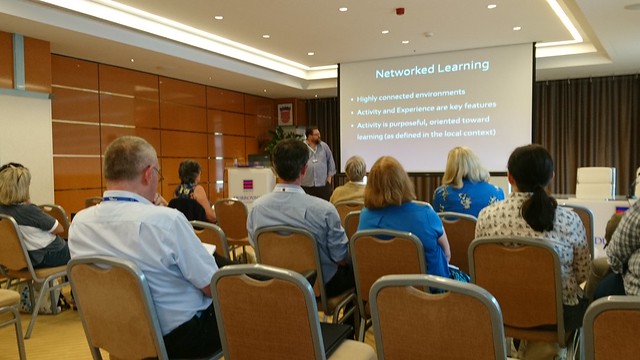
| Who is doing 'Networked Learning' here? |
It was such an honour to chair this morning's parallel session. We had some of that famous networked learning concept creep between Nina and Jens, David and Vivian's papers. To my mind, the conference has always permissively allowed even the likes of me (Johnson, 2008) to play with the standing conference definition of networked learning. In this post I draw attention back to the ancient csalt definition of NL quoted in full here: http://csalt.lancs.ac.uk/jisc/definition.htm
Networked LearningWe define 'networked learning' as:learning in which C&IT is used to promote connections: between one learner and other learners, between learners and tutors; between a learning community and its learning resources.Some of the richest examples of networked learning involve interaction with on-line materials and with other people. But use of on-line materials is not a sufficient characteristic to define networked learning.The interactions between people in networked learning environments can be synchronous, asynchronous or both. The interactions can be through text, voice, graphics, video, shared workspaces or combinations of these forms. Consequently the space of possibilities for networked learning, and the space of potential student experiences, is vast.
This definition makes it plain that the authors, for obvious reasons, stated that, for them, networked learning with 'on-line materials' was insufficient to be considered networked learning. They required 'interaction... with other people in networked learning environments'.
But this morning some are saying that this is also missing something.
The point was made, with approval, that the networked learning conference does networked learning. Further to the seminar, I want to play back Nina's thesis (today, and in 2012) that, to qualify, and even succeed for any amount of time worth the effort, NL depends, not just on interaction between people, but on the 'concrete' practice of what is being learnt via NL, i.e. to be deployed/practiced in actual contexts (like Nina's example of 'teachers in front of 5th Grade', or like us every 2nd year @NLConf for David and Vivian's paper).
In other words, and with an eye to the neoliberalism killing off the very idea of a university, networked learning conference delegates, by definition, have to regularly meet up in person, physically co-located, to achieve networked learning worthy of the name.
This leads to another related point, and that is, that the original definition also asserts a focus on (digital) information technology.
As at least a sop to the csalt definition, we can run with the idea that the
technology, especially digital information technology use, can be tacit,
or remain understated... Partly because it makes a refreshing change to
downplay tech. Of course IT is implicated - someone in the room will be
tweeting or whatever, regardless of how that affects their ability to
concentrate on what's really going on in the room.
If we put the definition up for an arguably timely refresh, what would we end up with if IT was dropped altogether from the definition, left implicit, and instead of it there was a requirement to 'meet up in person'...? How would such a definition read? What are the implications for the future of the nascent field as it moves towards life without the presence of its first generation scholars?
Given the above, how does the networked learning conference, community and delegates, 'do' networked learning?
Put Denmark, May 2020 in your diary to find out because it seems like 'being at the conference' is important.
David and Vivian: https://networkedlearningsconferenc.sched.com/mobile/#session:4fcca80244f37df85cfc1c043d14d16c
Nina:
Nina in 2012: http://www.networkedlearningconference.org.uk/past/nlc2012/abstracts/pdf/dohn.pdf
PS. I foolishly determined to write this blog post on my phone. This went ok in evernote, even if the hyperlinks were not automatically being picked up so that gets a real faff to sort out on a phone. Then I copy/pasted the text into the blogger app which went ok apart from losing the links again - should have known better. The next gotcha was when I dared to add a picture to the post. This was possibly too high resolution for the app to cope with at some level so it failed to publish and I had to copy the text into another new post but by that time had lost the will to try and tidy up the hyperlinks etc. This morning, I have revised the text, added the hyperlinks, added a photo, tweaked formatting - so much easier than on my phone.
PS. I foolishly determined to write this blog post on my phone. This went ok in evernote, even if the hyperlinks were not automatically being picked up so that gets a real faff to sort out on a phone. Then I copy/pasted the text into the blogger app which went ok apart from losing the links again - should have known better. The next gotcha was when I dared to add a picture to the post. This was possibly too high resolution for the app to cope with at some level so it failed to publish and I had to copy the text into another new post but by that time had lost the will to try and tidy up the hyperlinks etc. This morning, I have revised the text, added the hyperlinks, added a photo, tweaked formatting - so much easier than on my phone.


 Posts
Posts


