2. A lot of hot air and political capital is invested in the quest to make patent and profoundly effective use of learning technologies. It's a common enough rhetoric that frames academics as resisting opportunities to make the most of an institution's considerable investment in software licenses, hardware, support etc. With their specialist knowledge of the potential affordances of technology, learning technologists do learning itself potential harm by endorsing the 'academic as Luddite' line. This overlooks the need to attend to what the student is actually doing in terms of learning. As Goodyear and Carvalho (2014), when learning tasks are set for students, there is a 'loose coupling' between task and activity where the student interprets and engages with the task requirements. 'Teaching-as-design' should attain greater significance in people's minds than any given learning technology per se. A well-constructed reading list can be a powerful 'learning technology' but enacting this sort of view does not make headline-grabbing demands on an institution's infrastructure and attention. Indeed, it potentially dissolves the need for whole layers of management and support... which makes me wonder why higher education took this technologistic road in the first place...
Showing posts with label Peter Goodyear. Show all posts
Showing posts with label Peter Goodyear. Show all posts
Saturday, July 22, 2017
On unsophisticated document dumps
It is said that staff do not use expensive, sophisticated learning technologies in sophisticated ways. Repeated audits over many years show that the virtual learning environment (VLE) is used as a 'document dump' (noting pejorative metaphor). This view trivialises situated use of 'documents'. I just came across an example of how documents are used by students in my data and thought I would share here. Very simply, a student mentioned how they were about to access a learning task guideline in the VLE to check if they were following it properly in preparation for working on it the following day. I'll just make two points, neither with any claims to 'originality', before I go back to my coding:1. The 'document' is framing the plans of the student, not just while they are accessing it but when they are not using the VLE at all, shaping their planned engagement in learning activity, as well as afterwards. The document itself and the words in it constitute the substantial learning technology, the one that is having a deep effect on the students' trajectory, their life as a learner. I think I'm being sensitised to this 'historical' angle by Gadamer...
2. A lot of hot air and political capital is invested in the quest to make patent and profoundly effective use of learning technologies. It's a common enough rhetoric that frames academics as resisting opportunities to make the most of an institution's considerable investment in software licenses, hardware, support etc. With their specialist knowledge of the potential affordances of technology, learning technologists do learning itself potential harm by endorsing the 'academic as Luddite' line. This overlooks the need to attend to what the student is actually doing in terms of learning. As Goodyear and Carvalho (2014), when learning tasks are set for students, there is a 'loose coupling' between task and activity where the student interprets and engages with the task requirements. 'Teaching-as-design' should attain greater significance in people's minds than any given learning technology per se. A well-constructed reading list can be a powerful 'learning technology' but enacting this sort of view does not make headline-grabbing demands on an institution's infrastructure and attention. Indeed, it potentially dissolves the need for whole layers of management and support... which makes me wonder why higher education took this technologistic road in the first place...
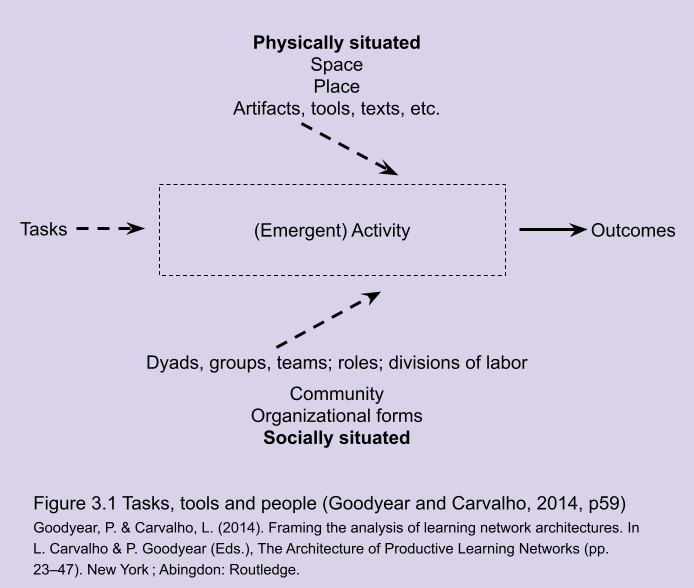
2. A lot of hot air and political capital is invested in the quest to make patent and profoundly effective use of learning technologies. It's a common enough rhetoric that frames academics as resisting opportunities to make the most of an institution's considerable investment in software licenses, hardware, support etc. With their specialist knowledge of the potential affordances of technology, learning technologists do learning itself potential harm by endorsing the 'academic as Luddite' line. This overlooks the need to attend to what the student is actually doing in terms of learning. As Goodyear and Carvalho (2014), when learning tasks are set for students, there is a 'loose coupling' between task and activity where the student interprets and engages with the task requirements. 'Teaching-as-design' should attain greater significance in people's minds than any given learning technology per se. A well-constructed reading list can be a powerful 'learning technology' but enacting this sort of view does not make headline-grabbing demands on an institution's infrastructure and attention. Indeed, it potentially dissolves the need for whole layers of management and support... which makes me wonder why higher education took this technologistic road in the first place...


Thursday, February 12, 2015
Design for learning
People talk about 'blended learning' as if it is something worth making a distinct point about. The only thing it is distinct from is 'undesigned' learning... where the 'instructor' (in cases where there is one) has, for whatever reason, not designed it (enough). The T P sea K framework of M ! s h r a & K o e h l € r is, in my view, a typology that introduces unhelpful distinctions (feel free to google it, I'm not linking to it from here ;). The T(=tech) needs to become part of what we do as instructors in the way that it is when we learn to drive or act generally in the world. For me, T P sea K is basically P - pedagogy.
I tweeted a link the other day, the heavily critical one by New Media in Monash. Within the hour, Dr K o e h l € r had favourited it and followed me, little me. That was simply too keen for my liking.
I tried to rationalise this as I checked him out... As I viewed his 'trap' from the inside, it occurred to me that I still had a chance to get out. Happy to say, clearly I did escape.
What I saw in there disturbed me though. K o e h l € r's actions on Twitter and the decor of his web presence meant just one thing: money. Someone is making money out of these acronyms. It doesn't matter if the theory is shaky, just like the learning styles stuff, there is good money to be made and people will buy it, walking away satisfied customers, thanking you very much. We might take a generous view of all this and say, well, they have to make a living somehow. But the thing that worries me the most is the effect on education research and theory in general. T P sea K is just P. That's the beating heart of it. It's not a new insight and provides us with another niche theory that does not hold much promise for building meaningfully upon. What it has is the potential for meme-like caché amongst those interested enough to care about teaching but in too much of a hurry to really care about building theory with greater explanatory power (e.g. Policy makers with the power to dictate various curricula). So, with more than a glance towards LCT, we get yet another confusing segment along the horizontal plane of the theory landscape (which now resembles a massive sprawling shanty town - sorry this simile is not quite as PC as I would normally align with) instead of something which genuinely has potential to build and be built upon, advancing theory AND practice in education.
Here is a design principle I think has some reflective power to positively influence practice:
 |
| pensive moi - because every post needs a picture and I was feeling low on creativity |
Here is a design principle I think has some reflective power to positively influence practice:
"design for learning networks will normally be improved if attention is paid to the little things that allow participants' activity to shift smoothly between the digital and the material." p270If you cant do pedagogy then get some help or give up now.
Goodyear, Peter, and Lucila Carvalho. “Synthesis.” In The Architecture of Productive Learning Networks, 259–76. New York ; Abingdon: Routledge, 2014.
Monday, April 7, 2014
Peter Goodyear comment in response to Neil Selwyn
I decided to post from the conference having greatly enjoyed Neil Selwyn's keynote. I had been anticipating his session with Chris Jones for a while and would have loved Chris to have been able to participate more rather than keeping to the chairing role. Anyway, there were some useful contributions from the floor and one of those was from Peter Goodyear...
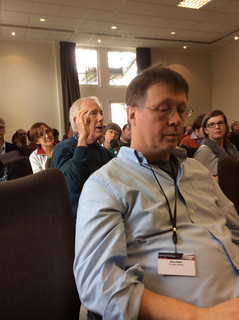 "I enjoyed that talk much more than I really wanted to. The point that I keep grappling with is that if you've got the luxury of working for a living where what you have to produce can be critique then there is not so much of a problem with this.
Many people who work in the edtech area do not earn their living in that way and they have to engage in various forms of action, and that action is very constrained by the politics, the economics, etc. of the circumstances in which they're operating. And so, the question for me then is to what extent can a critical perspective, disposition or midset, become a resource for action in those constrained circumstances and it seems to me that part of the answer is to develop an ability to understand what the scope for action is in a specific set of circumstances so that one can ask questions about what is doable amongst a range of things that might be doable and what action one might then take.
And I think that gels with your notion of being modest about the effects that we can have and not trying to be revolutionary and change all the world.
The one thing I do then worry about is that if you've got the freedom to act as a critical commentator you can always trump that local action, you can always say, "hey, yeah, but it's pointless really'."
There were several other contributions from the floor which amounted to a plea along the same lines from where each person was speaking. Someone even admitted that pessimism was getting the better of them...
Subscribe to:
Posts (Atom)

 Posts
Posts


