2. A lot of hot air and political capital is invested in the quest to make patent and profoundly effective use of learning technologies. It's a common enough rhetoric that frames academics as resisting opportunities to make the most of an institution's considerable investment in software licenses, hardware, support etc. With their specialist knowledge of the potential affordances of technology, learning technologists do learning itself potential harm by endorsing the 'academic as Luddite' line. This overlooks the need to attend to what the student is actually doing in terms of learning. As Goodyear and Carvalho (2014), when learning tasks are set for students, there is a 'loose coupling' between task and activity where the student interprets and engages with the task requirements. 'Teaching-as-design' should attain greater significance in people's minds than any given learning technology per se. A well-constructed reading list can be a powerful 'learning technology' but enacting this sort of view does not make headline-grabbing demands on an institution's infrastructure and attention. Indeed, it potentially dissolves the need for whole layers of management and support... which makes me wonder why higher education took this technologistic road in the first place...
Showing posts with label learning technologists. Show all posts
Showing posts with label learning technologists. Show all posts
Saturday, July 22, 2017
On unsophisticated document dumps
It is said that staff do not use expensive, sophisticated learning technologies in sophisticated ways. Repeated audits over many years show that the virtual learning environment (VLE) is used as a 'document dump' (noting pejorative metaphor). This view trivialises situated use of 'documents'. I just came across an example of how documents are used by students in my data and thought I would share here. Very simply, a student mentioned how they were about to access a learning task guideline in the VLE to check if they were following it properly in preparation for working on it the following day. I'll just make two points, neither with any claims to 'originality', before I go back to my coding:1. The 'document' is framing the plans of the student, not just while they are accessing it but when they are not using the VLE at all, shaping their planned engagement in learning activity, as well as afterwards. The document itself and the words in it constitute the substantial learning technology, the one that is having a deep effect on the students' trajectory, their life as a learner. I think I'm being sensitised to this 'historical' angle by Gadamer...
2. A lot of hot air and political capital is invested in the quest to make patent and profoundly effective use of learning technologies. It's a common enough rhetoric that frames academics as resisting opportunities to make the most of an institution's considerable investment in software licenses, hardware, support etc. With their specialist knowledge of the potential affordances of technology, learning technologists do learning itself potential harm by endorsing the 'academic as Luddite' line. This overlooks the need to attend to what the student is actually doing in terms of learning. As Goodyear and Carvalho (2014), when learning tasks are set for students, there is a 'loose coupling' between task and activity where the student interprets and engages with the task requirements. 'Teaching-as-design' should attain greater significance in people's minds than any given learning technology per se. A well-constructed reading list can be a powerful 'learning technology' but enacting this sort of view does not make headline-grabbing demands on an institution's infrastructure and attention. Indeed, it potentially dissolves the need for whole layers of management and support... which makes me wonder why higher education took this technologistic road in the first place...
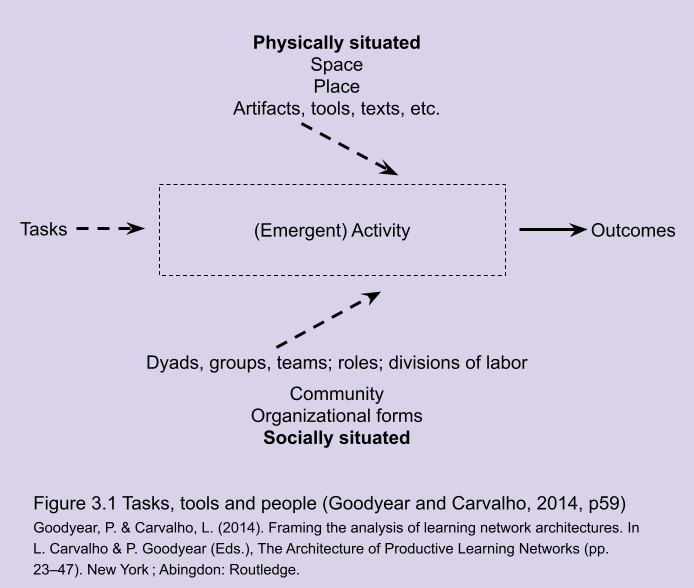
2. A lot of hot air and political capital is invested in the quest to make patent and profoundly effective use of learning technologies. It's a common enough rhetoric that frames academics as resisting opportunities to make the most of an institution's considerable investment in software licenses, hardware, support etc. With their specialist knowledge of the potential affordances of technology, learning technologists do learning itself potential harm by endorsing the 'academic as Luddite' line. This overlooks the need to attend to what the student is actually doing in terms of learning. As Goodyear and Carvalho (2014), when learning tasks are set for students, there is a 'loose coupling' between task and activity where the student interprets and engages with the task requirements. 'Teaching-as-design' should attain greater significance in people's minds than any given learning technology per se. A well-constructed reading list can be a powerful 'learning technology' but enacting this sort of view does not make headline-grabbing demands on an institution's infrastructure and attention. Indeed, it potentially dissolves the need for whole layers of management and support... which makes me wonder why higher education took this technologistic road in the first place...


Wednesday, April 20, 2016
The Pundit's Folly
I know a great little book by Sinclair Ferguson, 'The Pundit's Folly' - the cover is as good as the contents... It's an adaptation of (from my searching) a cover of a magazine printed in 1898. The basic thing is that a masked clown is seen to dangle a crown above a crowd of people all trying to grasp it. This is reflecting on the way that we keep chasing that illusive 100% uptime whereas it is quite hard to achieve. I'll bet someone has done a curve plotting server uptime. The crowd in this case is the learning technologist (broadly defined, whether academic, 'para-academic', management or nobly propping up systems). Each one believes. But do their beliefs in or about technology (for automation or enhancement) take attention away from the 'irreducible distinctiveness' of all human beings? (a phrase attributable to Jeremy Knox http://edinburgh.academia.edu/JeremyKnox ). For me, this is one of the important aspects of Bennett et al's new article in the BJET. We chase automation and/or enhancement but at what cost?

Bennett, S., Dawson, P., Bearman, M., Molloy, E. and Boud, D. (2016), How technology shapes assessment design: Findings from a study of university teachers. British Journal of Educational Technology. doi: 10.1111/bjet.12439
Thursday, October 29, 2015
Embedding digital scholarship requires academic leadership
 I am just really pleased with the way my little group of BSc students have risen to the challenge of submitting a "first 500 words on Evidence-based practice" to peermark. They are very lacking in confidence and find academic work thoroughly alien to their world of clinical expertise. It is a real joy and privilege to share a room with these guys as they open up about the challenges of embodied knowledge practice and the extreme skill that they deploy on a daily basis. But now they have to do knowledge work of a scholarly kind, and very often that is 'digital scholarship'. As module leader, I'm bringing them on in small steps and they're responding famously (we argue about whether these are 'small' steps :). As far as why this is happening, Glover et al's recent paper points back in my direction...
 However, the overarching theme evident from the interviews was that the preference of the module leader is the main driver of the use of technology in submission and feedback, even when they will be taking little part in the process.Any success I'm reporting here is not intended as a cheap boast. For me it highlights the necessary agency of academics to set the direction and expectations for what happens in terms of embedding digital literacy practices into the fabric of core learning and teaching activity. Something too many shy away from. Perhaps there is an analogy with children and the significance of their birth parents. No para-academic (e.g. learning technologist, librarian, administrator) can carry exactly the same weight of authority. We're living in times with earnest attempts to apply a 'division of labour' to university activities with the promise of more student centredness, maximising consistency, increasing efficiency and driving down costs. Whether or not these are worthy and entirely necessary goals in a time of 'austerity', we should consider whether tweaking the academic out of higher education may leave us with something other than 'higher education'. Is that what we want and who decides? For my part, I'll do what I can to help my students develop current scholarly practices and habits, many of which will incur 'the digital'.
GLOVER, Ian et al. Making connections: technological interventions to support students in using, and tutors in creating, assessment feedback. Research in Learning Technology, [S.l.], v. 23, oct. 2015. ISSN 2156-7077. Available at: <http://www.researchinlearningtechnology.net/index.php/rlt/article/view/27078>. Date accessed: 29 Oct. 2015. doi:http://dx.doi.org/10.3402/rlt.v23.27078.
Thursday, March 19, 2015
Networked Learning as a pedagogy again
I can't quite escape from the ideas I was talking about in 2008. Media choice and the pedagogy of and around that choice impacts behaviour and somehow we're liable to miss that.
Scenario: Evaluation. You have a large class of students (say 200) and you want to get a good response-rate to the routine end-of-module evaluation. The organisation would quite like this process to cost nothing at all. So, from paper-based, or perhaps optical mark read forms, the organisation has moved to online evaluations. This has coincided with a dramatic drop in response-rates. The choice of media has distanced the student from anything but the slightest amount of pedagogic influence over them (a paper just published refers to this kind of thing as 'pedagogic distance' - see Westberry and Franken 2015 - I think it is a massive issue). Even in a large lecture setting, if a lecturer hands out paper forms and requests students to complete them, the students are likely to comply. This is likely to do with the social form of the lecture as an event within which students immediately cede control to the person managing the session. Once out of the lecture, the spell is broken and all kinds of things come between the student and the online form.
Given that it is not very manageable to troop them all off to an IT room, unless you have the facility and could tie the evaluation in with some other desirable learning opportunity.
You could try an audience response system but that would be expensive and quite clumsy to administer. Apart from anything else, an evaluation with more than a few summary questions is going to feel like an imposition on the students and would, in my view, be an abuse of the lecturer's pedagogic power. There have been many discussions about the issue of students using their mobiles in lectures.
I suggested projecting a very large QR Code that points to the online form. Google's URL shortener serves up a QR Code and still works even though it gets a bit blurry when enlarged. [Note of caution - check URL's unless you can absolutely trust the source - perhaps use something like https://scanurl.net - good to use a checker that looks harder than just what's at the other end of your click - thanks to Martha for suggesting this edit 😁)
Any student with a smartphone ought to be able to follow the link. Clearly that is fantasy. It would be a good idea to warn the students in advance or at least to ask them to ensure they have or know where to find a QR Code Scanner app.
Even if they don't complete the form there and then, at least their browser is at the right page and they may go on to complete it later.
So it is hoped that merely by using the lecture setting to display the QR Code and allocating a few minutes to complete the form will increase response rates. Whether this will work after the novelty factor wears off, and what proportion of students who are not capable of scanning the code will feel disenfranchised and possibly put in a worse evaluation than they might have otherwise...!!! As they say, that's an empirical question...
But has the lecturer's action of introducing the QR Code in this scenario promoted connections? Is that an example of networked learning pedagogy in action? The definition says nothing about having students having to be learning at a distance...
Then there's the whole thing about the way that my role here means that I get to sit in meetings and try and join the things that I hear with the 'stuff I know' to come up with useful suggestions. Its serendipity. If learning technologists want to influence learning and teaching practice, they may have to sit in and tune in to yet more meetings.
Westberry, Nicola, and Margaret Franken. “Pedagogical Distance: Explaining Misalignment in Student-Driven Online Learning Activities Using Activity Theory.” Teaching in Higher Education 20, no. 3 (April 3, 2015): 300–312. doi:10.1080/13562517.2014.1002393.
Scenario: Evaluation. You have a large class of students (say 200) and you want to get a good response-rate to the routine end-of-module evaluation. The organisation would quite like this process to cost nothing at all. So, from paper-based, or perhaps optical mark read forms, the organisation has moved to online evaluations. This has coincided with a dramatic drop in response-rates. The choice of media has distanced the student from anything but the slightest amount of pedagogic influence over them (a paper just published refers to this kind of thing as 'pedagogic distance' - see Westberry and Franken 2015 - I think it is a massive issue). Even in a large lecture setting, if a lecturer hands out paper forms and requests students to complete them, the students are likely to comply. This is likely to do with the social form of the lecture as an event within which students immediately cede control to the person managing the session. Once out of the lecture, the spell is broken and all kinds of things come between the student and the online form.
Given that it is not very manageable to troop them all off to an IT room, unless you have the facility and could tie the evaluation in with some other desirable learning opportunity.
You could try an audience response system but that would be expensive and quite clumsy to administer. Apart from anything else, an evaluation with more than a few summary questions is going to feel like an imposition on the students and would, in my view, be an abuse of the lecturer's pedagogic power. There have been many discussions about the issue of students using their mobiles in lectures.
I suggested projecting a very large QR Code that points to the online form. Google's URL shortener serves up a QR Code and still works even though it gets a bit blurry when enlarged. [Note of caution - check URL's unless you can absolutely trust the source - perhaps use something like https://scanurl.net - good to use a checker that looks harder than just what's at the other end of your click - thanks to Martha for suggesting this edit 😁)
Even if they don't complete the form there and then, at least their browser is at the right page and they may go on to complete it later.
So it is hoped that merely by using the lecture setting to display the QR Code and allocating a few minutes to complete the form will increase response rates. Whether this will work after the novelty factor wears off, and what proportion of students who are not capable of scanning the code will feel disenfranchised and possibly put in a worse evaluation than they might have otherwise...!!! As they say, that's an empirical question...
But has the lecturer's action of introducing the QR Code in this scenario promoted connections? Is that an example of networked learning pedagogy in action? The definition says nothing about having students having to be learning at a distance...
Then there's the whole thing about the way that my role here means that I get to sit in meetings and try and join the things that I hear with the 'stuff I know' to come up with useful suggestions. Its serendipity. If learning technologists want to influence learning and teaching practice, they may have to sit in and tune in to yet more meetings.
Westberry, Nicola, and Margaret Franken. “Pedagogical Distance: Explaining Misalignment in Student-Driven Online Learning Activities Using Activity Theory.” Teaching in Higher Education 20, no. 3 (April 3, 2015): 300–312. doi:10.1080/13562517.2014.1002393.
Subscribe to:
Posts (Atom)

 Posts
Posts


