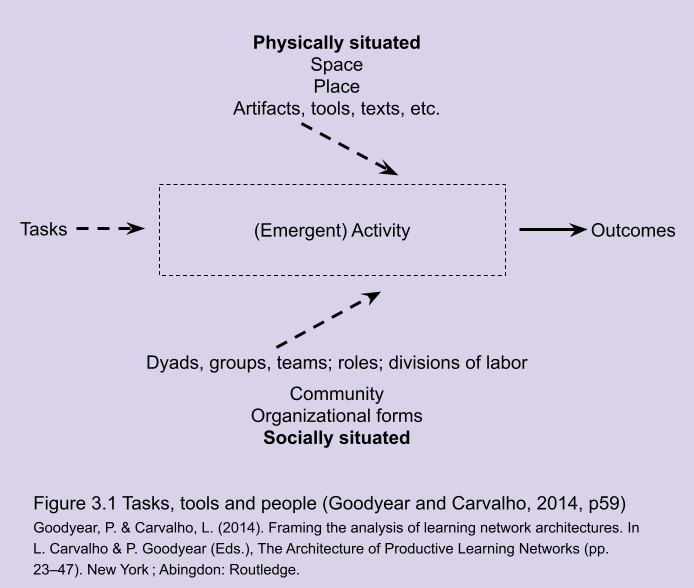
2. A lot of hot air and political capital is invested in the quest to make patent and profoundly effective use of learning technologies. It's a common enough rhetoric that frames academics as resisting opportunities to make the most of an institution's considerable investment in software licenses, hardware, support etc. With their specialist knowledge of the potential affordances of technology, learning technologists do learning itself potential harm by endorsing the 'academic as Luddite' line. This overlooks the need to attend to what the student is actually doing in terms of learning. As Goodyear and Carvalho (2014), when learning tasks are set for students, there is a 'loose coupling' between task and activity where the student interprets and engages with the task requirements. 'Teaching-as-design' should attain greater significance in people's minds than any given learning technology per se. A well-constructed reading list can be a powerful 'learning technology' but enacting this sort of view does not make headline-grabbing demands on an institution's infrastructure and attention. Indeed, it potentially dissolves the need for whole layers of management and support... which makes me wonder why higher education took this technologistic road in the first place...
Showing posts with label VLE. Show all posts
Showing posts with label VLE. Show all posts
Saturday, July 22, 2017
On unsophisticated document dumps
It is said that staff do not use expensive, sophisticated learning technologies in sophisticated ways. Repeated audits over many years show that the virtual learning environment (VLE) is used as a 'document dump' (noting pejorative metaphor). This view trivialises situated use of 'documents'. I just came across an example of how documents are used by students in my data and thought I would share here. Very simply, a student mentioned how they were about to access a learning task guideline in the VLE to check if they were following it properly in preparation for working on it the following day. I'll just make two points, neither with any claims to 'originality', before I go back to my coding:1. The 'document' is framing the plans of the student, not just while they are accessing it but when they are not using the VLE at all, shaping their planned engagement in learning activity, as well as afterwards. The document itself and the words in it constitute the substantial learning technology, the one that is having a deep effect on the students' trajectory, their life as a learner. I think I'm being sensitised to this 'historical' angle by Gadamer...
2. A lot of hot air and political capital is invested in the quest to make patent and profoundly effective use of learning technologies. It's a common enough rhetoric that frames academics as resisting opportunities to make the most of an institution's considerable investment in software licenses, hardware, support etc. With their specialist knowledge of the potential affordances of technology, learning technologists do learning itself potential harm by endorsing the 'academic as Luddite' line. This overlooks the need to attend to what the student is actually doing in terms of learning. As Goodyear and Carvalho (2014), when learning tasks are set for students, there is a 'loose coupling' between task and activity where the student interprets and engages with the task requirements. 'Teaching-as-design' should attain greater significance in people's minds than any given learning technology per se. A well-constructed reading list can be a powerful 'learning technology' but enacting this sort of view does not make headline-grabbing demands on an institution's infrastructure and attention. Indeed, it potentially dissolves the need for whole layers of management and support... which makes me wonder why higher education took this technologistic road in the first place...
2. A lot of hot air and political capital is invested in the quest to make patent and profoundly effective use of learning technologies. It's a common enough rhetoric that frames academics as resisting opportunities to make the most of an institution's considerable investment in software licenses, hardware, support etc. With their specialist knowledge of the potential affordances of technology, learning technologists do learning itself potential harm by endorsing the 'academic as Luddite' line. This overlooks the need to attend to what the student is actually doing in terms of learning. As Goodyear and Carvalho (2014), when learning tasks are set for students, there is a 'loose coupling' between task and activity where the student interprets and engages with the task requirements. 'Teaching-as-design' should attain greater significance in people's minds than any given learning technology per se. A well-constructed reading list can be a powerful 'learning technology' but enacting this sort of view does not make headline-grabbing demands on an institution's infrastructure and attention. Indeed, it potentially dissolves the need for whole layers of management and support... which makes me wonder why higher education took this technologistic road in the first place...


Monday, September 20, 2010
The ideal VLE
Reluctantly, I was tried to form an answer to the question of what would make up the ideal Virtual Learning Environment... I usually maintain that point 1 is the most important in the following list:

- Do a good job of handling programme/cohort/group affiliations and keep those affiliations while handing students over into groups within 3rd party tools like Grademark and Questionmark Perception.
- Integrate with GradeMark and QuestionmarkPerception
- Allow easy and quick organisation of content (I spend half my day waiting for the browser to refresh)
- Allow easy dissemination of information - via announcements and bulk email
- Allow interaction, perhaps via discussion list, blog, wiki-type activity, with reasonably fine-grained permissions
- Allow embedding video, and various other media... like this (cue attractive picture to liven things up a bit):
- Where collaborative authoring is required as part of the activity, the wiki could show me, and other readers, what a person has done very easilly and transparently on a page. One of the things that happens with wikis is that people lose ownership of what they've done in the wiki which is a dissincentive for them to engage with it. In our present wiki tool (campuspack), clicking on the person's name in the list of page authors just takes me to their profile. I want to click on it and see their contribution highlighted, and possibly even award them marks for that there and then... see next point...
- I would like to be able to allow easy, on the fly, recording and reporting of my and others' assessment of what they've done, indicating their opinion, along a series of criteria and levels of performance - perhaps a pop-up box that I could define. This would break with the notion of single points of assessment, and therefore learning for that assessment alone, as students would be contributing and being rewarded for their ongoing activity.
- Assessment of networked learning activity. Whether we like it or not, assessment drives everything in Higher Education. Students are unlikely to share without some incentive linked to their final assessment. For networked learning, how can I monitor what each person has done in terms of contributing to everyone's learning. This could be based on stats for access, usage, and other's usage and opinions of what I, the student, have done. For example, if I share a hyperlink through my blog to a resource I get a mark, if someone clicks on it I get a mark, if someone indicates they find what I did useful, that gets a mark for both of us, if someone includes a link to my blog post, that gets a mark, and so on... Over a period of years, this could build into quite a large amount of 'marks', a powerful evidence-base upon which to evaluate someone's performance as a collaborator/sharer/team-player. This would be a way to reward the individual for work done in support of others... always a tricky matter for assessment. Hopefully the fine-grained rewards would assure participants that each and every contribution was counting for something.
Where to put this wiki...
Students are working in groups to produce a page of evaluated links to resources around a certain topic in healthcare. Where do I put the wiki?
In their own VLE module? Sadly, this limits the audience and thus the students' awareness of that audience.
In their programme-level VLE module where all students on their programme can access it? As this task is run twice a year, it's soon going to get hard to navigate and muggins is going to have to maintain it. At least building one per cohort keeps it manageable with no overhead of maintaining it.
Somewhere all of our students can see it? This would mean farming them out to a different wiki-space not normally associated with learning and teaching.... politically sensitive! Plus the need to do all the 'gardening' implied in '2' above.
Sigh - looks like I stay with option one. It's, as ever, a trade-off between wanting to do the right thing educationally and yet keep it manageable...
In their own VLE module? Sadly, this limits the audience and thus the students' awareness of that audience.
In their programme-level VLE module where all students on their programme can access it? As this task is run twice a year, it's soon going to get hard to navigate and muggins is going to have to maintain it. At least building one per cohort keeps it manageable with no overhead of maintaining it.
Somewhere all of our students can see it? This would mean farming them out to a different wiki-space not normally associated with learning and teaching.... politically sensitive! Plus the need to do all the 'gardening' implied in '2' above.
Sigh - looks like I stay with option one. It's, as ever, a trade-off between wanting to do the right thing educationally and yet keep it manageable...
Thursday, June 18, 2009
Pedagogically neutral? No
I do not know what happened just then, but I suddenly saw a little fissure in my (relative) complacency about choice of VLE. Ah yes, I know what it was... I was transcribing something a student had said to me in a recent interview.
[I] don't really put anything into blackboard, it's more what I get out, out of itWell now, I am not about to bash corporate VLE's. Of course, it's the way that we use the tools that matters most. But part of 'networked learning' ought to be the establishment of links, of all shapes and sizes and levels and types of activity.... but it struck me that they ought not to be one-way streets. In the perception of this student, a discussion list was alien to the overall thrust of blackboard. How can the whole enterprise of being a student @university be re-branded and re-engineered so that the statement above can be inverted to read:
[I - or, better, we] really put loads into blackboard, it's more what I put in, into it
Wednesday, June 3, 2009
Coopman's First Monday essay about Blackboard
Sorry to pull off the cream of this one and not add much commentary but this, her last sentance, especially needs some mulling over:
Although Blackboard designers structure the course platform for efficiency and profit, instructors and students need a course environment optimized for learning and performative teaching.First Monday, Volume 14:6 - 1st June.
Monday, February 23, 2009
killing connections
We've had a few experiments with inter-professional learning recently that tried to use the VLE. Unfortunately, as a tutor comes to it 'straight out of the box', the VLE is more interested in limiting connections with anyone except the select few who teach or learn on the module. This is backed, of course, from several angles by policy: marketing and targeting a module, financing it, populating it, protecting copyright of it; these are all made possible by fixing cost-centres at the module/programme level. With a will, we have found ways to circumvent the boundaries, thanks to support from the centre. But the dreamt-of viral learning, 'learning as infection', mediated through a 20th Century VLE, with its faux social network, demands the demolishing of unhelpful constraints. Yet, ironically, these constraints are they which direct my salery safely to my bank account and certificates to help students get a salery... is this vicious/virtuous circle going to be disrupted any-time soon?
Subscribe to:
Posts (Atom)

 Posts
Posts


