Showing posts with label networked learning conference. Show all posts

Wednesday, April 22, 2020

NLindex

A few weeks ago, a brief exchange on twitter highlighted a difficulty common to many fields: how to enable a way in to the literature.
There are lots of ways of providing an index. Google Scholar does some of it. I don't think any of the databases cover the NL conference archive, and we might want to include other non-NLC sources anyway. We have a saying, 'he who has the vision gets the job'.
Joe used Kumu for his Knowledge Hub. Kumu allows for various ways of presenting the same information, so was preferred over CMAPS, as good as that is. Kumu's free for public maps. Anything that requires effort needs to be reasonably durable and Kumu appears to have that. It also has an CSV import, which, data cleaning notwithstanding, could save a lot of time hand-coding. There may be no way to avoid some of that.
Although in lockdown, Alice kindly sent me 3 exports from the SCHED app used in the previous 3 conferences. So, when I can get to it, this presents a viable way forward. It will still require a fair bit of data cleaning and there are some decisions to make... E.g. whether to re-host the papers, where possible. If anyone is interested to help with this project, do get in touch. There could be some bread pudding in it for you...

Bread pudding

Wednesday, May 16, 2018

NL conference does NL

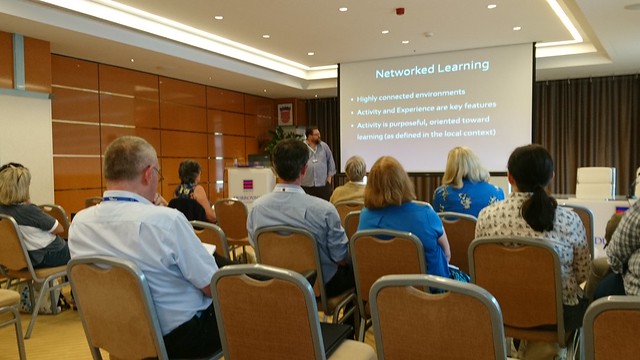
Ben Kehrwald presents on Cognitive Load Theory and NL
Who is doing 'Networked Learning' here?

It was such an honour to chair this morning's parallel session. We had some of that famous networked learning concept creep between Nina and Jens, David and Vivian's papers. To my mind, the conference has always permissively allowed even the likes of me (Johnson, 2008) to play with the standing conference definition of networked learning. In this post I draw attention back to the ancient csalt definition of NL quoted in full here: http://csalt.lancs.ac.uk/jisc/definition.htm
Networked Learning
We define 'networked learning' as:
learning in which C&IT is used to promote connections: between one learner and other learners, between learners and tutors; between a learning community and its learning resources.
Some of the richest examples of networked learning involve interaction with on-line materials and with other people. But use of on-line materials is not a sufficient characteristic to define networked learning.
The interactions between people in networked learning environments can be synchronous, asynchronous or both. The interactions can be through text, voice, graphics, video, shared workspaces or combinations of these forms. Consequently the space of possibilities for networked learning, and the space of potential student experiences, is vast. 
This definition makes it plain that the authors, for obvious reasons, stated that, for them, networked learning with 'on-line materials' was insufficient to be considered networked learning. They required 'interaction... with other people in networked learning environments'.
But this morning some are saying that this is also missing something.
The point was made, with approval, that the networked learning conference does networked learning. Further to the seminar, I want to play back Nina's thesis (today, and in 2012) that, to qualify, and even succeed for any amount of time worth the effort, NL depends, not just on interaction between people, but on the 'concrete' practice of what is being learnt via NL, i.e. to be deployed/practiced in actual contexts (like Nina's example of 'teachers in front of 5th Grade', or like us every 2nd year @NLConf for David and Vivian's paper). 
In other words, and with an eye to the neoliberalism killing off the very idea of a university, networked learning conference delegates, by definition, have to regularly meet up in person, physically co-located, to achieve networked learning worthy of the name.
This leads to another related point, and that is, that the original definition also asserts a focus on (digital) information technology.
As at least a sop to the csalt definition, we can run with the idea that the technology, especially digital information technology use, can be tacit, or remain understated... Partly because it makes a refreshing change to downplay tech. Of course IT is implicated - someone in the room will be tweeting or whatever, regardless of how that affects their ability to concentrate on what's really going on in the room.
If we put the definition up for an arguably timely refresh, what would we end up with if IT was dropped altogether from the definition, left implicit, and instead of it there was a requirement to 'meet up in person'...? How would such a definition read? What are the implications for the future of the nascent field as it moves towards life without the presence of its first generation scholars? 
Given the above, how does the networked learning conference, community and delegates, 'do' networked learning?
Put Denmark, May 2020 in your diary to find out because it seems like 'being at the conference' is important.

Nina:
Nina in 2012: http://www.networkedlearningconference.org.uk/past/nlc2012/abstracts/pdf/dohn.pdf 

PS. I foolishly determined to write this blog post on my phone. This went ok in evernote, even if the hyperlinks were not automatically being picked up so that gets a real faff to sort out on a phone. Then I copy/pasted the text into the blogger app which went ok apart from losing the links again - should have known better. The next gotcha was when I dared to add a picture to the post. This was possibly too high resolution for the app to cope with at some level so it failed to publish and I had to copy the text into another new post but by that time had lost the will to try and tidy up the hyperlinks etc. This morning, I have revised the text, added the hyperlinks, added a photo, tweaked formatting - so much easier than on my phone.

Monday, August 22, 2016

Networked Learning metaphors #23432: The Synapse

It seems like a classic ivory tower pursuit.... a bunch of academics coming up with metaphors for networked learning, and especially getting whimsy about it. But this was one of the memorable aspects of the conference back in May. However, as ideas, metaphors can spawn insights, hone analysis or enhance practical organisation of learning and teaching. Perhaps it is something we need to do more of...
I want to publish some work I did last year but I have lost access to a book I need to refer to. It was an expensive library acquisition from Lancaster. I guess, for a small charge, they'd send it to me again as a distance learner. But I thought I would see if I could get it at home. Apparently not. This would be best done through an inter-library loan, so I was told. This conjures up the horrible chain of events that is the British Library's secure download system. It is the information management equivalent of traveling by slow-motion train crash.
At the networked learning conference I cheekily added some bits to my presentation that were not in the 'full' paper - especially the postscript:


I think I mentioned 'chain of weak links' back in 2008. In this slide though, I've likened the network in networked learning, to a neural network, especially the aspect of neural networks that sees a weaker messages fail to arrive due to synapses. In my 'resource' example, the library has proved to be a synapse too far, for now... In competition with everything else I have going on, the added hurdle to access the resource I need, although only requiring a small further push, is crowded out. I found time to write this instead of submitting the ILL request!
For me, motivation is one of the things that strengthen the signal, allowing it to traverse synapses. Motivation is a key aspect of learning, and the intentionality which actor-network theory is said to lack, by the way.

I should just add that the other two points on this slide refer to the following:

Monday, April 7, 2014

Peter Goodyear comment in response to Neil Selwyn

I decided to post from the conference having greatly enjoyed Neil Selwyn's keynote. I had been anticipating his session with Chris Jones for a while and would have loved Chris to have been able to participate more rather than keeping to the chairing role. Anyway, there were some useful contributions from the floor and one of those was from Peter Goodyear...

Pictures from Networked Learning Conference 2014"I enjoyed that talk much more than I really wanted to. The point that I keep grappling with is that if you've got the luxury of working for a living where what you have to produce can be critique then there is not so much of a problem with this. 
Many people who work in the edtech area do not earn their living in that way and they have to engage in various forms of action, and that action is very constrained by the politics, the economics, etc.  of the circumstances in which they're operating. And so, the question for me then is to what extent can a critical perspective, disposition or midset, become a resource for action in those constrained circumstances and it seems to me that part of the answer is to develop an ability to understand what the scope for action is in a specific set of circumstances so that one can ask questions about what is doable amongst a range of things that might be doable and what action one might then take.
And I think that gels with your notion of being modest about the effects that we can have and not trying to be revolutionary and change all the world.
The one thing I do then worry about is that if you've got the freedom to act as a critical commentator you can always trump that local action, you can always say, "hey, yeah, but it's pointless really'."

There were several other contributions from the floor which amounted to a plea along the same lines from where each person was speaking. Someone even admitted that pessimism was getting the better of them...

Tuesday, April 17, 2012

Two symposiums, two current debates

Gale's on disciplinarity (links to the papers) and Chris's on technology and networked learning. I will just say a tiny bit about the latter. If we want to say anything meaningful about technology and its relationship, not to say impact, on learning, what kind of a question is that? In days when very strong claims are being made about changes to people's brains etc., Chris Jones was arguing (link to the symposium papers), IMHO sensibly, that taking some kind of 'multiple realities' view, as Martin Oliver did, or even a clever critical realist perspective, as Walker and Creanor did, makes it pretty difficult to generalise. Indeed, taking an ontological route of enquiry isnt nice at all. I went off in that direction a while back and liken it to chasing a white rabbit into a black hole which I later discovered to be my own navel (I do have a picture but I'll spare you...)
Project: Alice in Wonderland
If, however, you embark on a 'ways of knowing' kind of inquiry, this is altogether more manageable and potentially productive. There has to be something 'everyday' about the terms we use and theory we generate (Wenger's point from the last post). Sadly, we may end up smelling of the 'snake oil' we would prefer to reprobate. Yes, I may even have to use words like e-learning occasionally.
OK then, you made me do it, I'll say something about disciplinarity in the field. Gale chaired this symposium. It started off predictably with the assertion that none of us would say we were native 'networked learning researchers', our backgrounds were in other disciplines.... er... all except me that is, as I mentally retraced my chequered academic history, before the PGCE that finally got me interested in learning, and then, a couple of years later with CSALT, where I grafted on to networked learning.
But the nature of the field IS interdisciplinary. That makes chasing down the literature very difficult and, as I'm finding with the worthy Mehlenbacher's book, no matter how hard you try, and he does try hard, you'll miss someone who said something 'off your radar'. The other thing it did is make me cynical: I'd marvel that new papers appear from disparate disciplines hailing the latest innovation that was more clearly explained in the 1980's. And that in spite of all the searching of databases and availability of the literature in such a young field. I've rolled up at previous conferences tutting as I wondered if anyone would bother to pick up the threads of networked learning from the past, or whether they'd even bother to cite a definition. This time I came a bit more relaxed because I felt that although a certain amount of fuzziness was likely, at least the conference was happening again, we were all back together again, and the networked learning community already has a golden seam of quality to tap into. It was delightful to become acquainted with Sheena Banks there. At one point we sidled up to Peter Goodyear and asked if he'd consider updating the Guidelines, to which he mumbled something about money... But that's ok, they're still one of the best things JISC sponsored. But the point of learning for me was that we can wallow and bemoan the messiness of the field or rejoice in the potential for boundary crossing and 'edge effects'.

Friday, April 6, 2012

Networked Learning Conference 2012

The Networked Learning Conference has come around and gone again and I have been greatly privileged to attend. It is an excellent conference from many perspectives, being research-based, bi-annual (gives time for fresh ideas to be reported on), top-quality venues, well designed programme, broad minded, while retaining the core theoretical focus, I could go on... This year I have another reason to be thankful since the opening plenary was a 3-some between researchers involved in sustainability, especially Tara Fenwick and Judi Marshall. I remember being struck by this at the Fifth conference in Lancaster, when Vera SolĂ­s, one of the speakers from Latin America, told of how broadband for a month costed many people the same as a week's earnings. I think the conference this time were profoundly challenged by the complexity of how to make a positive impact. There were interesting points from the floor too: someone lamented the commercialisation of higher education as somehow domesticating students into consumers, dulling their radical edge.
It was also a privilege to chair one of the parallel sessions which just meant keeping the four presenters to time and they were all well behaved so that was easy. 
Later we were taken the short hop to the The Gouvernement (Province House) of Limburg, where the Maastricht Treaty was signed after a civic welcome from Mark Verheijen and the Rector of Maastricht University. With the recurring threat of financial melt-down, we still live in these 'good days', while they last: just to be so comfortably off that we can spend days discussing networked learning is worth pausing to reflect upon.
My presentation went ok - see below for the slides (the paper will appear on the conference website as usual before long). I was sad not to have any data to report but there has been a serious hold-up with piloting Community Equity at Cardiff University (failed JISC bid attempt in 2011, competing priorities, etc.). Information Services are trying to roll-out IBM Connections in May and this is soaking up any spare capacity for trying out something in the name of educational research...
Other memories: Peter Goodyear up to mischief again, John Dron and Terry Anderson touting https://landing.athabascau.ca to a fairly non-plussed audience (seems like an academic attempt at Google Circles). Personal chats with so many: especially valuable were those with Sheena Banks and Hillary Thomas. Ettiene Wenger was there for most of the conference and he was concerned that we were in danger of losing the 'human' in learning, as an experience of meaningfulness, personhood and becoming. He said that his theories had gained wide acceptance because it talks to people in a way that they could recognise themselves within. He worried that talk of 'agency in the network' and 'de-centering the person' which is important to understand and true at some level but not necessarily the most useful way of thinking. He asked if he was just being 'quaint', the tensions between old and new are real but to what extent does it still matter to focus on the experience of being in a network, of learning as a human experience, of meaningfulness, of engaging, being alive, over relationships, time and space. The danger of talking about networks is to analyse them to the extent that we privilege our position and begin to feel we know more than the people we are accountable to.
In spite of this, Chris Jones' symposium focusing on the role of technology in networked learning was, for me, one of the more substantial and significant contributions to networked learning theory. Was it possible to say something, even something fairly general, about the effects of technology without falling into technological determinism...?
Apart from the academic activity, I spoiled myself on camping, rambling, cycling, and stopping over in Brussels via AirBnB on Wednesday night on the way home: photos from my adventures are on Flickr.